Mai Po Nature Reserve is Hong Kong's most vital wetland — a Ramsar-listed site that has quietly delivered Nature-based Solutions for decades, and now home to the WWF Jockey Club Smart Wetland Management Project.
Font size:
A
A
A
WWF-Hong Kong
Long before "Nature-based Solutions" became a global framework, Mai Po Nature Reserve was already quietly delivering them. For decades, this Ramsar-listed Wetland of International Importance has served as a silent hero - purifying water, buffering floods, storing carbon, and sheltering countless species along the East Asian-Australasian Flyway. Through WWF-Hong Kong's proactive, long-standing management, Mai Po has sustained these vital ecosystem services for the benefit of surrounding communities, including the rapidly developing Northern Metropolis. Now, with the WWF Jockey Club Smart Wetland Management Project (SWMP), we are taking this legacy further - harnessing smart technology with conservation to strengthen Mai Po's role as a world-class example of Nature-based Solutions (NbS).
Formally recognised by the UN in 2022, NbS refers to actions that protect, restore, and sustainably manage ecosystems to address environmental challenges while simultaneously delivering human well-being, climate resilience, and biodiversity benefits. At Mai Po, this is not a new concept - it is a living reality, and SWMP gives it the tools of the 21st century.
Smart Technology in Service of Nature
Backed by a nearly HK$80 million grant from The Hong Kong Jockey Club Charities Trust, SWMP represents a major milestone in comprehensively integrating smart technology across Mai Po’s wetland management. Building on years of IoT groundwork - with over 100 devices already deployed across the Reserve since 2022 - further smart facility installments are commencing over the coming three years, progressively scaling up reserve-wide coverage.
Three pillars drive this smart wetland conservation effort, each in service of nature:
Smart Hydrology — A smart sluice gate integrates real-time sensor data from the gei wais with weather forecasts from the Hong Kong Observatory, enabling automated, precision water management that responds dynamically to extreme weather events - a critical tool for climate resilience in an era of intensifying storms and rising sea levels.
WWF-Hong Kong
The smart sluice gate integrates real-time gei wai sensor data with Hong Kong Observatory forecasts, enabling precision water management that responds dynamically to extreme weather.
Smart Monitoring — A smart camera network, connected via an off-grid wireless system, feeds an AI species identification platform for real-time wildlife monitoring - with a particular focus on at-risk species such as the Black-faced spoonbill. GPS tracking further monitors migratory bird movement patterns, deepening our understanding of the Reserve's role along the East Asian–Australasian Flyway.
WWF-Hong Kong
A solar-powered camera trap network feeds an AI species identification platform for real-time wildlife monitoring — with a focus on at-risk species including the Eurasian otter.
Central Management System (CMS) — A centralised online platform enables wetland management staff to monitor smart hydrology and monitoring systems across the Reserve 24/7, facilitating real-time responses to changing conditions regardless of geographical and physical barriers — ensuring timely, informed decisions that keep Mai Po's ecosystems safe around the clock.
Together, these innovations do not replace nature - they listen to it more closely.
When Architects Meet the Wetland
WWF-Hong Kong
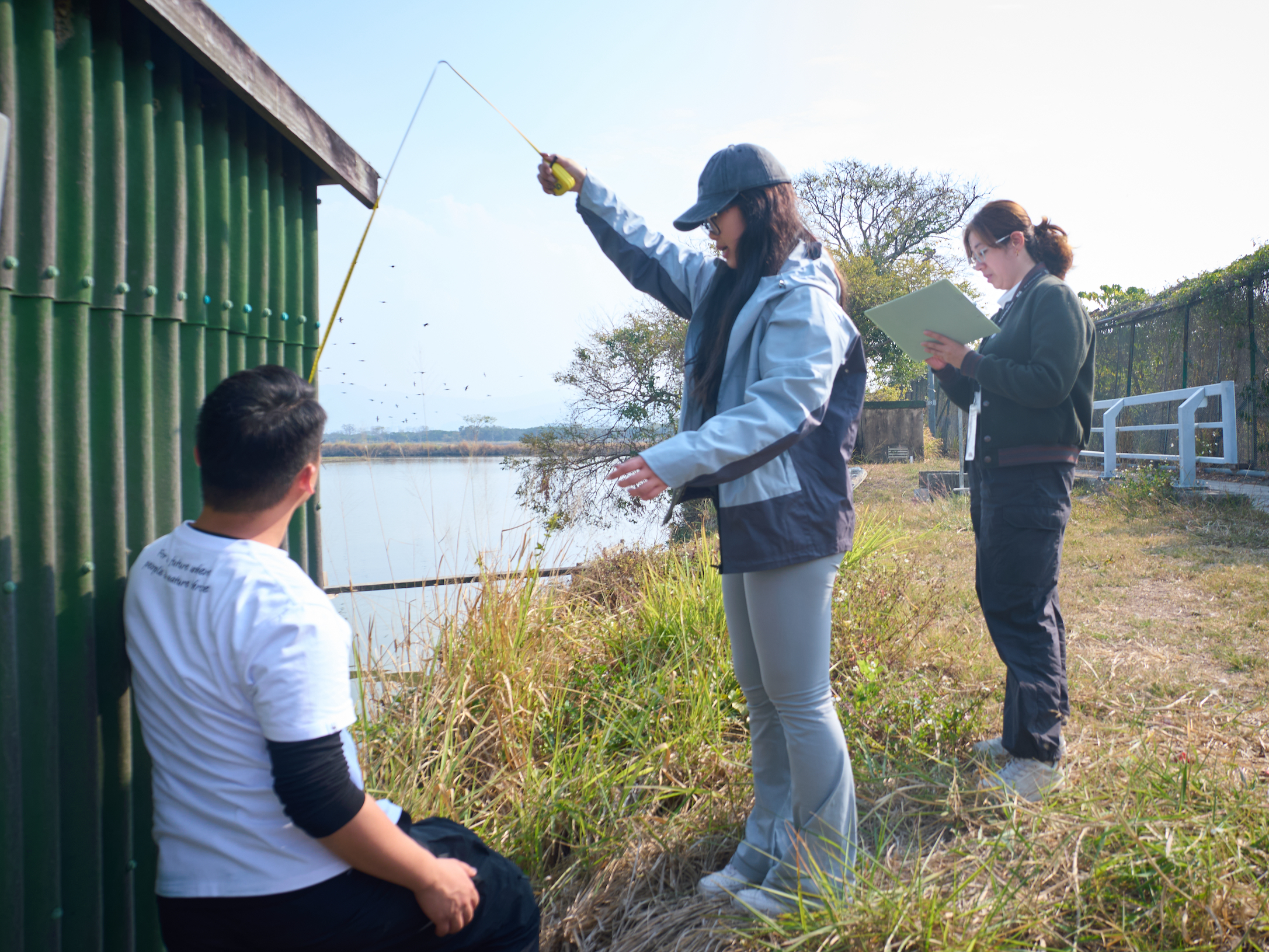
HKDI architectural design students explore Mai Po's landscape, measuring bird hide dimensions and observing the relationship between built structures and natural habitats.
Conservation cannot happen in isolation — it requires champions across every profession. Under SWMP, WWF-Hong Kong actively engages high-impact professional groups to broaden awareness of NbS values and empower diverse stakeholders to advocate for nature from within their own fields. Bringing this thinking into the design studio is especially vital: the decisions architects make today will shape how much room nature has tomorrow.
In late January 2026, SWMP extended its reach beyond the Reserve through a collaboration with the Hong Kong Design Institute (HKDI). Funded by The Hong Kong Jockey Club Charities Trust, WWF-Hong Kong hosted a three-day, two-night immersive workshop at Mai Po for HKDI architectural design students - challenging them to reimagine bird hide designs that enhance the visitor experience while actively contributing to biodiversity conservation.
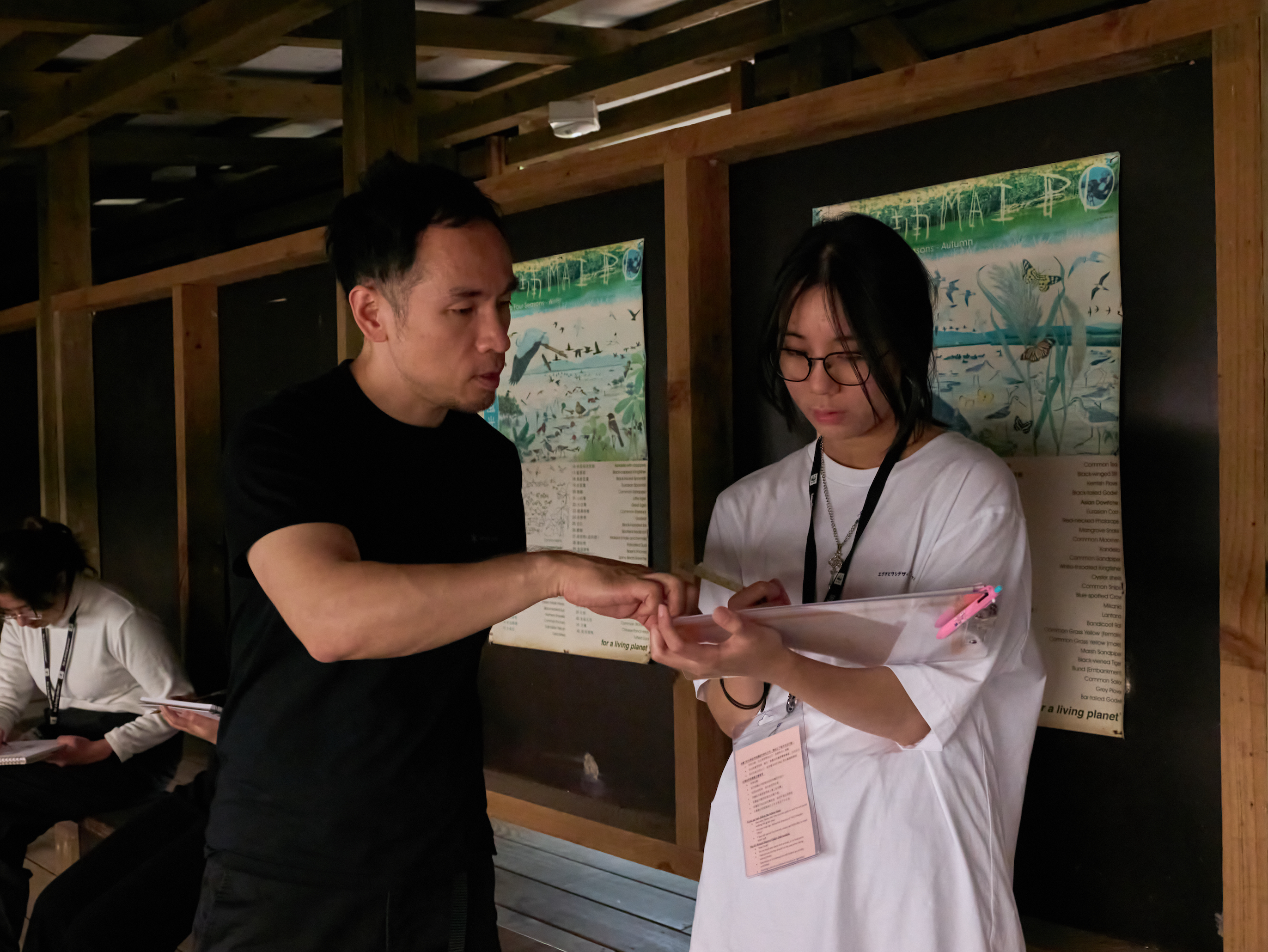
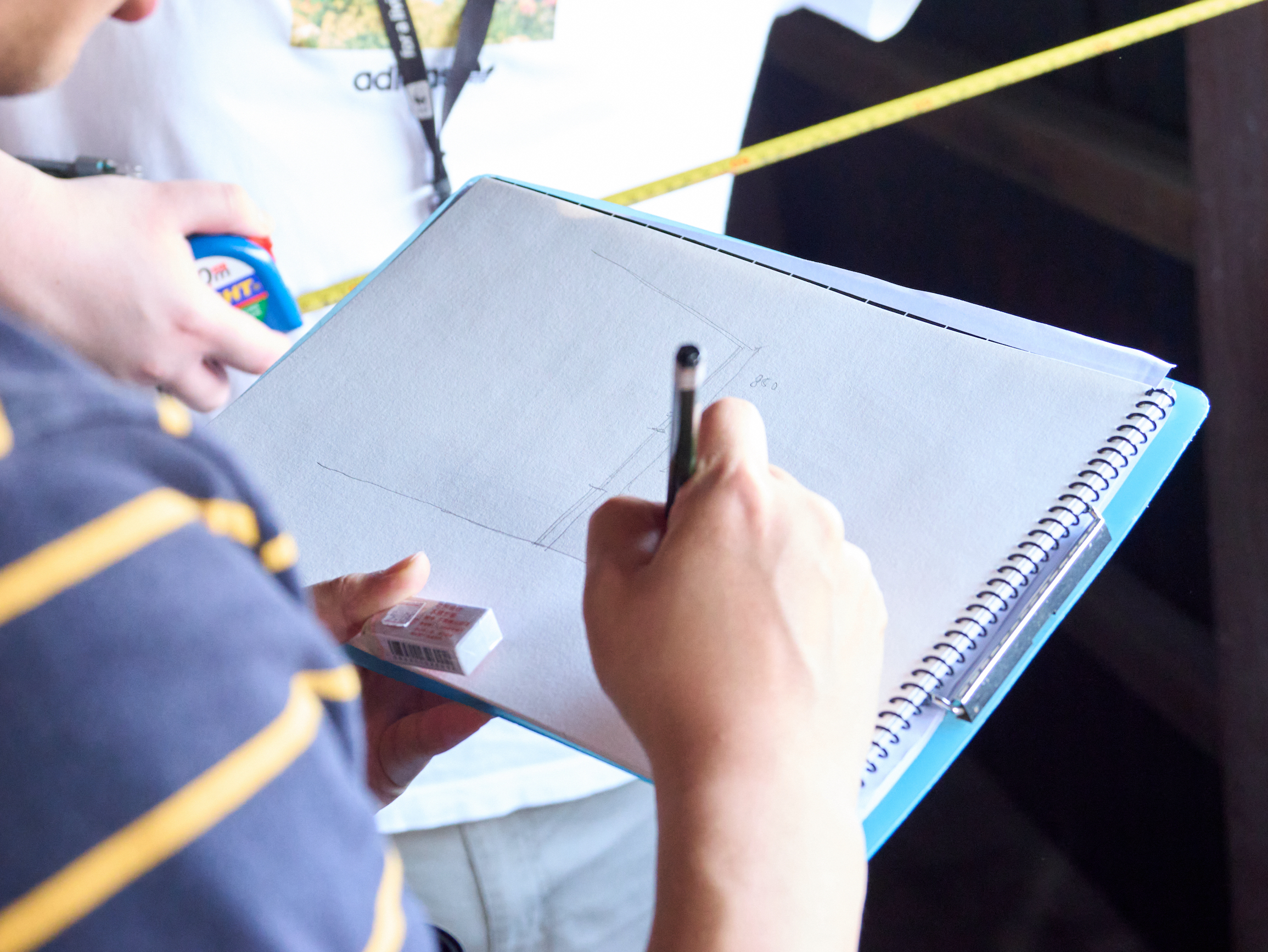
Guided by HKDI lecturer Kentaro Nagano, students explored the Reserve with both an architect's precision and an explorer's curiosity - measuring spatial dimensions, recording the interplay of light and shadow, and observing the subtle dynamics between people and the environment. The workshop also introduced students to wetland management principles and NbS, weaving conservation thinking directly into architectural practice. For the next generation of designers, Mai Po became more than a field trip - it became a masterclass in designing with nature, not just for people.
WWF-Hong Kong
Guided by HKDI lecturer Kentaro Nagano, students rediscover the intelligence of their own senses — experiencing the wetland's scale, sounds, and textures firsthand.
WWF-Hong Kong
Students were challenged to reimagine bird hide designs that enhance visitor experience while actively contributing to biodiversity conservation.
As Mr. Nagano reflects:
"Mai Po is a living site — rich with conservation history, ecological complexity, and layers of meaning that simply cannot be conveyed through textbooks alone. I wanted students to rediscover the intelligence of their own senses: to hear the wetland, smell it, feel the scale of a bird hide with their own bodies. Technology can support learning, but it cannot replace the direct experience of being on site. I hope these embodied observations stay with them well beyond this project, shaping every design decision in their future practice."
Student: NG King Hei, Elvis
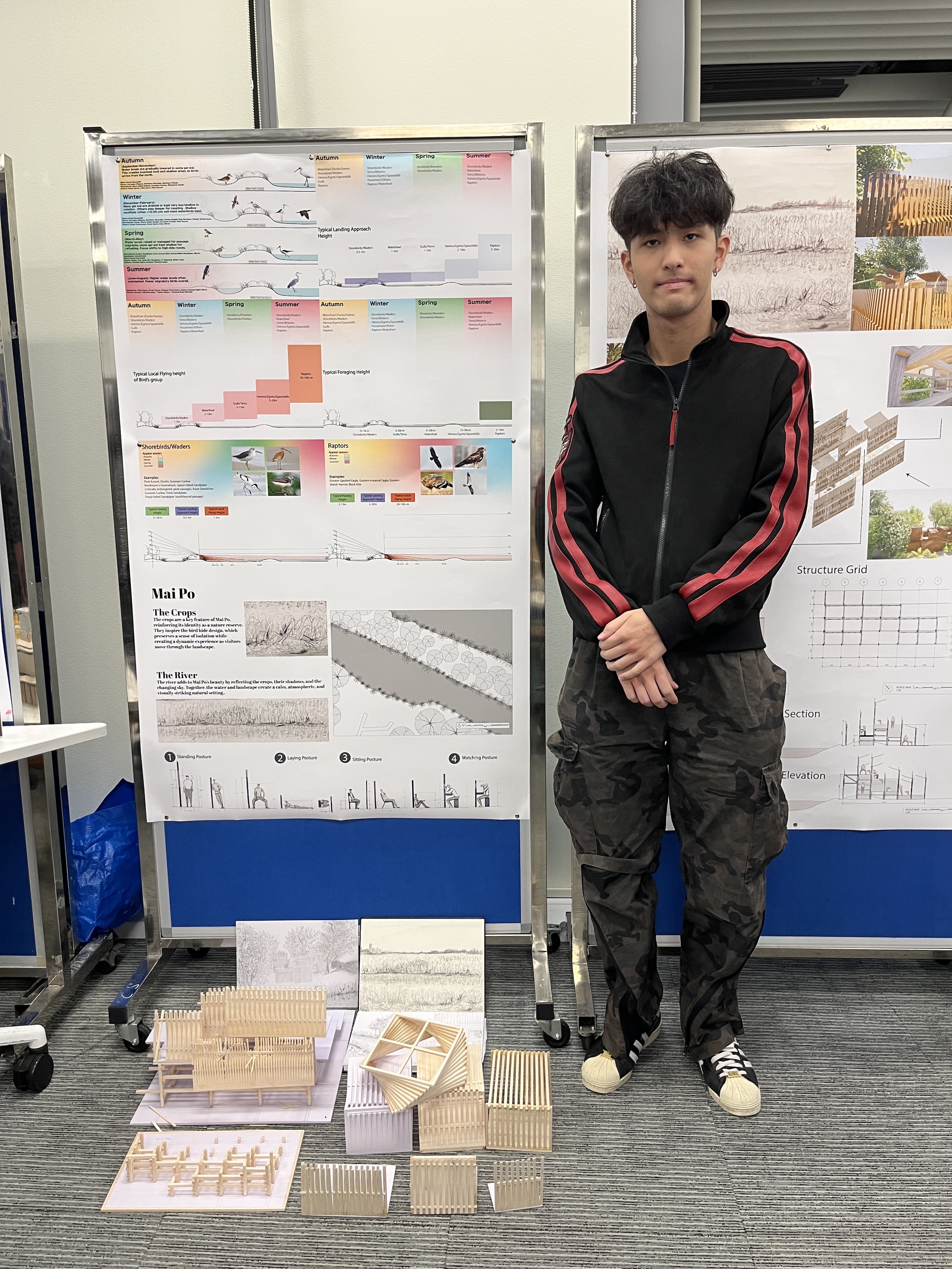
HKDI student Elvis Ng with his bird hide model. His design uses a low profile and divided rooms for quiet concealment, minimising disturbance to wildlife.
"Stepping into the bird hide for the first time was genuinely surprising. I hadn't expected it to be so dark inside — but that darkness is intentional, so the birds never notice the people watching them. That idea of quiet concealment really stayed with me, and it became the heart of my design. I wanted to create something that isolates visitors from the wildlife, but still feels beautiful and peaceful to be in. In my sketches, I designed bush-like walls that divide the space into smaller individual watching rooms, so birdwatchers don't disturb each other either. I also widened the corridors and kept the overall height below the tree line — so the structure quietly becomes part of the wetland."
Student 2: CHAN Pak Lam, Dorothy
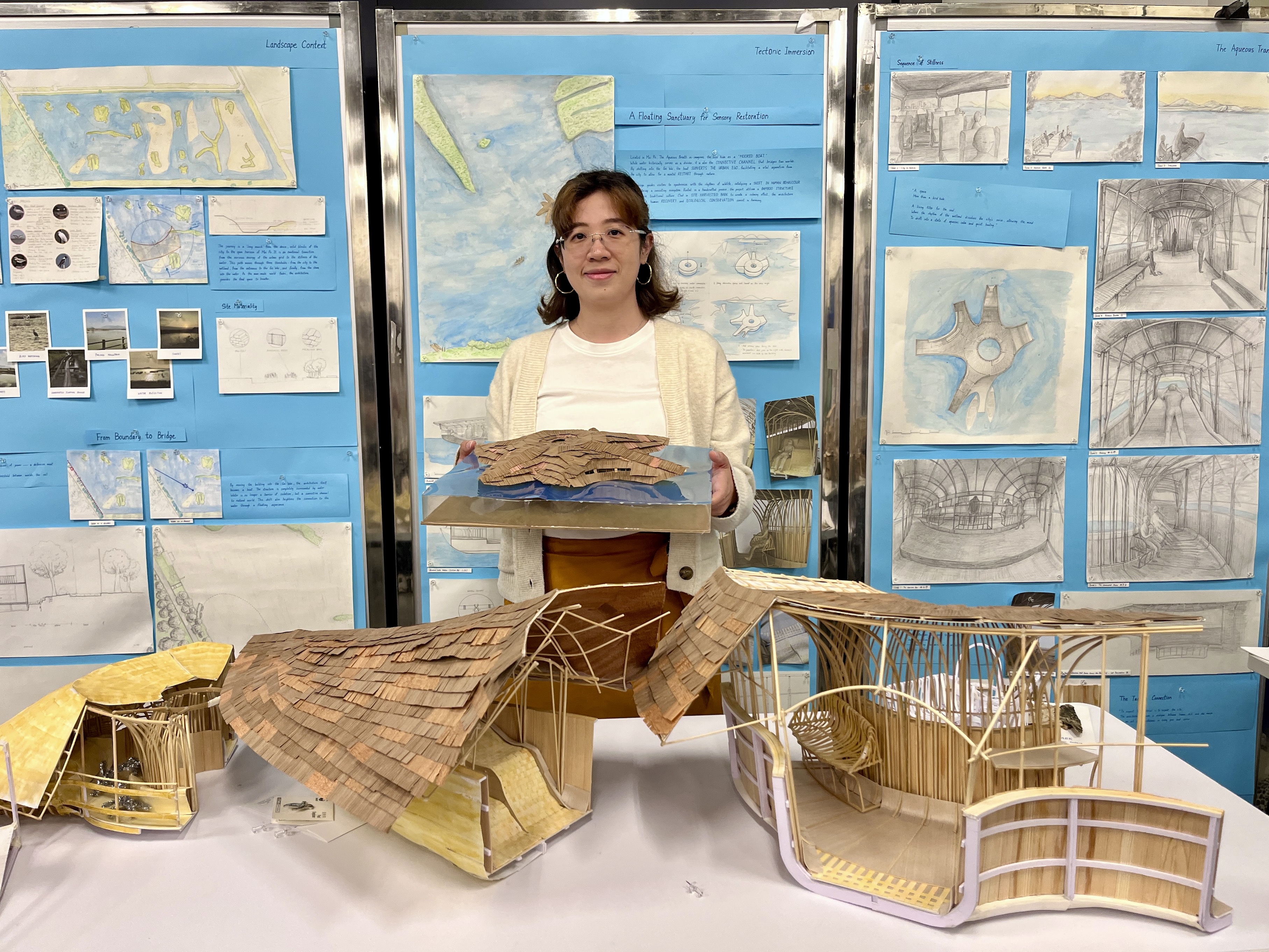
HKDI student Dorothy Chan with her architectural models. Using organic forms, her design creates a mutually beneficial sanctuary for both human restoration and wildlife shelter.
"The biggest challenge has been logistics — the structure sits right in the Gei Wai, and even travelling across the water creates ripples that spook the birds. That realisation shifted how I think about conservation architecture entirely. It's not just a viewing box; it's a space that asks people to respect nature's schedule and learn a new way of being.
To help the structure disappear, I'm drawing on organic forms — like the small islands already in the pond — and committing to site-sourced materials. I'm inspired by the fact that Mai Po's structures are built by the workers themselves, and I want to honour that handmade quality, so the hide feels like it genuinely belongs to this land.
What fascinates me most is the mental effect of the wetland. The stillness here can deeply influence how a visitor feels — and I believe a bird hide can be mutually beneficial: a sanctuary for people, and a physical shelter for the wildlife below."
Mr. Nagano further elaborates:
"This collaboration with WWF has been genuinely eye-opening. It has given us direct access to ecological knowledge and to areal conservation site that challenges our students to expand their design thinking in new directions.
For me, a bird hide is not simply a structure placed in the landscape. It is an interface between people, wildlife, and wetlands. Through this project, I hope students learn that architecture is not only about designing objects, but about shaping relationships — between people, wildlife, and the ecological conditions of the site. Conservation and architecture should not be treated as separate concerns; they can support one another in meaningful ways."
Conservation is a Community Endeavour
WWF-Hong Kong
Through the "Working with Nature Volunteer Programme" and "Mai Po Mentorship Programme", we invite the community to learn, contribute, and grow alongside Mai Po's ecosystems.
Conservation at Mai Po is a shared endeavour - and SWMP has opened its doors wide to the community. Since the project's launch, WWF-Hong Kong has welcomed participants through the "Working with Nature Volunteer Programme" - offering hands-on roles in interpretation, visitor management, and large-scale conservation events - as well as the "Mai Po Mentorship Programme", which pairs youth aged 18-30 with conservation and education professionals for immersive, career-building field experience.
Keen to get involved? Follow WWF-Hong Kong's channels for upcoming volunteer and engagement opportunities - because at Mai Po, there is always a role for those who care.
A Living Blueprint for the Future
As SWMP progresses, Mai Po is emerging as more than a nature reserve - it is becoming a regional model for climate resilience and nature-positive conservation, and a blueprint for the sustainable development of Hong Kong's Northern Metropolis. By demonstrating how smart wetland management and NbS can work hand in hand, this project sets anew benchmark for what urban-wetland coexistence can look like in the 21st century.
Stay connected with WWF-Hong Kong as we share more project milestones, stories from the field, and opportunities to get involved in the seasons ahead.
.jpeg)
.JPG)

.jpeg)
.jpeg)

%20WWF-Hong%20Kong.jpeg)
.jpg)