Sharp Island North recorded 77.5% coral coverage in 2025, which is the third highest amongst 36 Reef Check survey sites in Hong Kong, highlighting the urgent need for formal Marine Park designation.
Font size:
A
A
A
Hong Kong's waters are far richer than most people realise. Despite occupying just 0.03% of China's marine area, our seas are home to over 5,900 marine species, more than a quarter of all marine species recorded in China. Rapid coastal development, pollution, unsustainable fishing practices, heavy marine traffic, and excessive recreational use continue to threaten the resilience of these precious ecosystems. WWF has been dedicated to advocating the expansion of marine protected areas in Hong Kong for more than 10 years. During this period, the proportion of formally protected waters in Hong Kong increased from only about 2% to around 6%. To ensure a healthy and climate-resilient ocean for future generations, the pace of conservation action must accelerate.
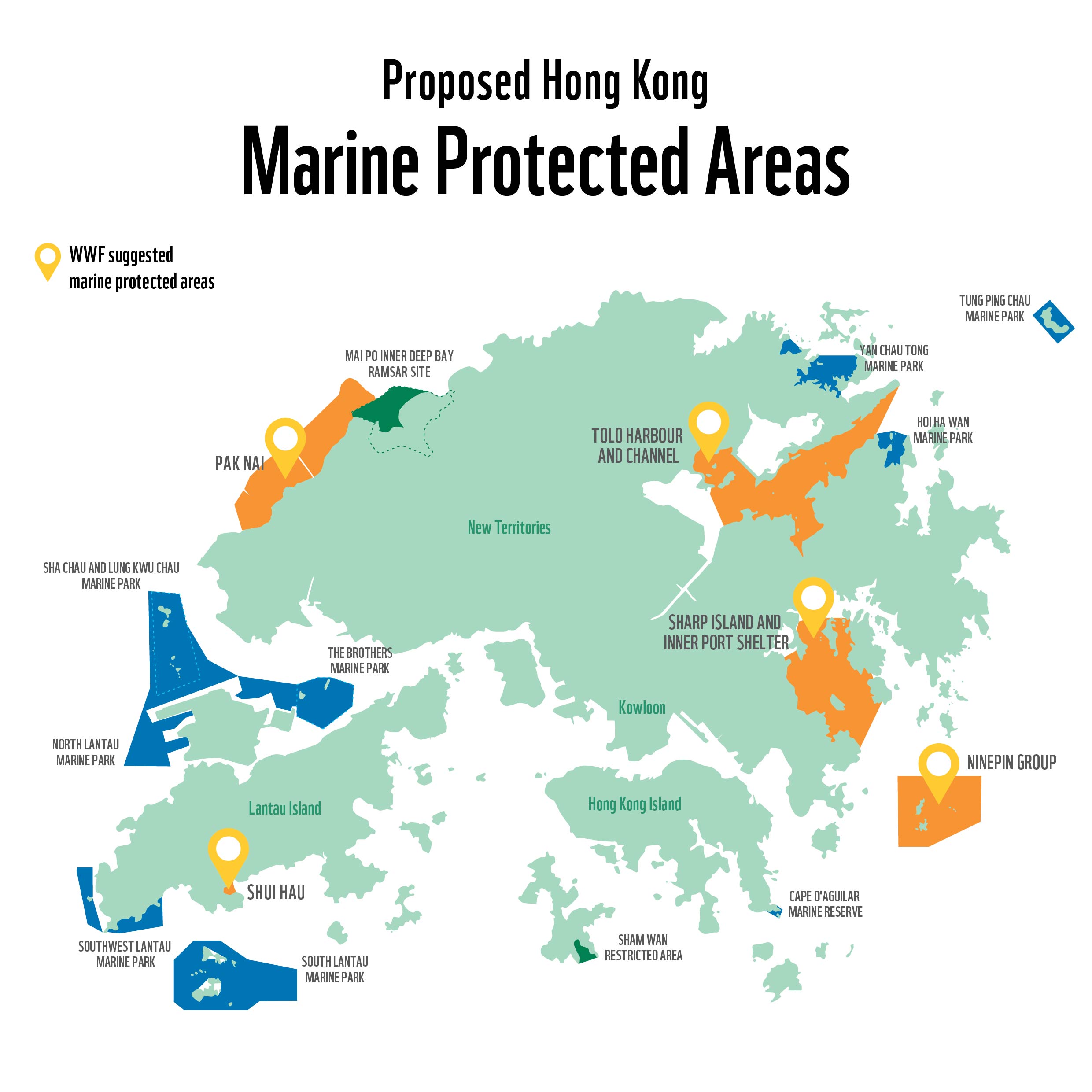
This is why WWF has launched a revamped ocean conservation roadmap, aligned with the Hong Kong Biodiversity Strategy and Action Plan (BSAP) 2035 target to achieve "an expanded network of effectively managed protected areas and other effective area-based conservation measures", to step up our advocacy for sustainable ocean governance across Hong Kong's waters. We are calling on society to focus collective conservation efforts especially at five priority sites: Shui Hau, Sharp Island and Inner Port Shelter, Tolo Harbour and Channel, and Pak Nai Ninepin Group.
WWF-Hong Kong
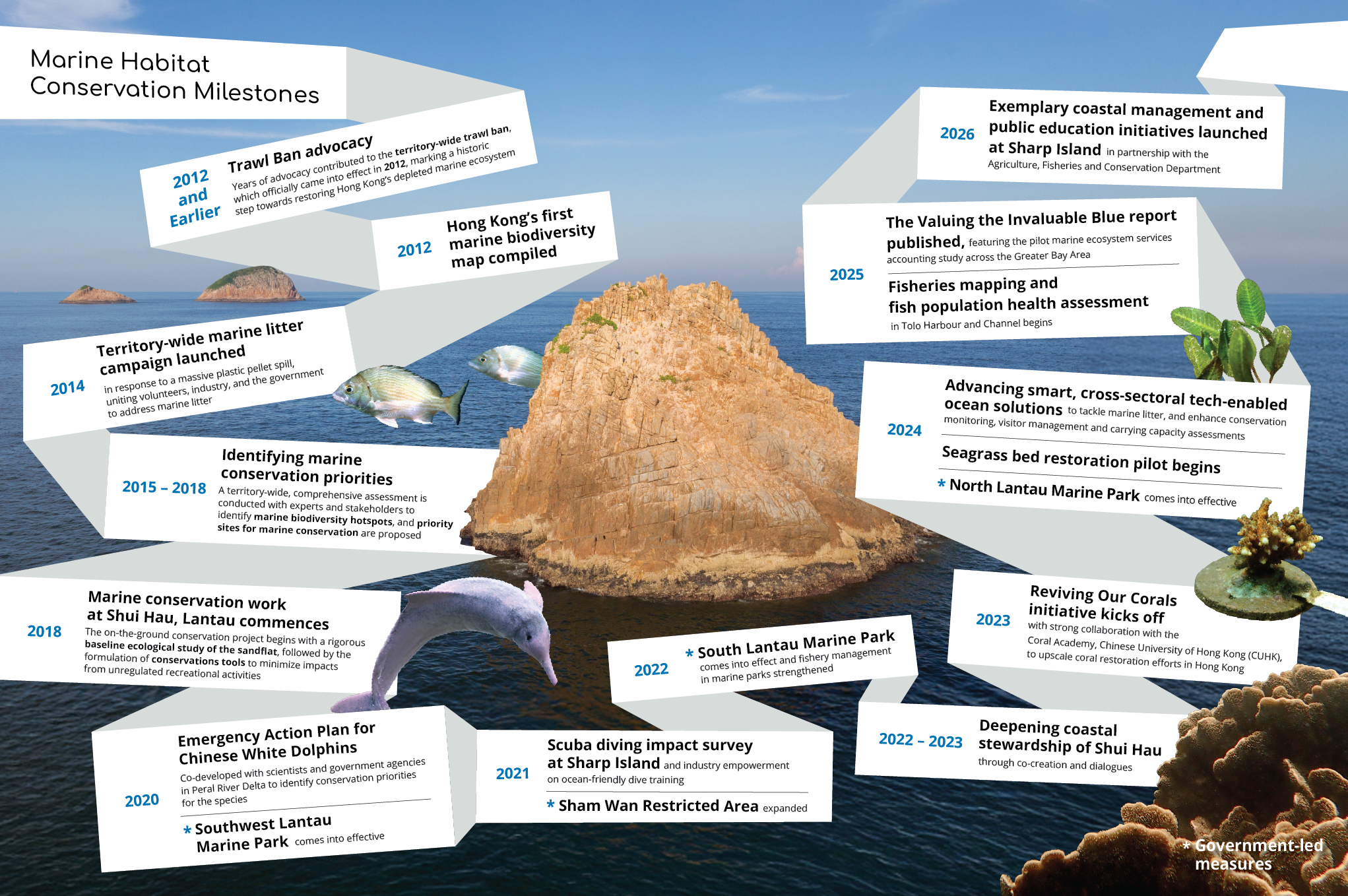
Tracing WWF’s marine conservation milestones over the years. While we celebrate these achievements, we urge the expansion of our Marine Protected Area network to ensure these vital ecosystems thrive for generations to come.
Four Strategies: Plan wisely. Protect what matters. Restore what’s lost. Innovate for a blue Future.
Our revamped roadmap is built on four key strategies. First, expand Marine Protected Areas (MPAs): well-designed and well-managed MPAs safeguard high-value habitats, rebuild fish populations, and enhance ecosystem services. Second, recognise and apply Other Effective area-based Conservation Measures (OECMs): a complementary approach that supports conservation beyond statutory protected areas and delivers long-term ecological benefits. Third, restore habitats: revitalising damaged ecosystems, including corals, seagrass meadows, and other key functional habitats, as nature-based solutions to enhance biodiversity and strengthen coastal resilience. Fourth, harness smart technologies: anchoring technology as an enabler of ocean governance, to strengthen the observe–analyse–respond–adapt cycle and enable conservation action to be scaled and delivered at speed.
WWF-Hong Kong
WWF has identified five ocean conservation priority sites across Hong Kong's waters, forming the backbone of our revamped ocean conservation roadmap.
Our Priority Sites
Shui Hau: Safeguarding a Living Sandflat
Tucked along the southern coast of Lantau Island, the interconnected ecosystems of Shui Hau support over 600 species, including 84 of conservation importance. Among them two of the world's four surviving horseshoe crab species: the endangered Chinese Horseshoe Crab (Tachypleus tridentatus) and the Mangrove Horseshoe Crab (Carcinoscorpius rotundicauda) root at the intertidal sandflat. Since 2018, multi-year surveys supported by 450 citizen scientists have tracked clam and horseshoe crab populations, recording declining clam density and confirming Shui Hau as a critical nursery ground. IoT devices, including water-level sensors, visitor counters, and badge trackers, have been deployed since 2024 to capture real-time data. Working with local, WWF co-created Hong Kong's first clam-digging Code of Conduct and clam gauge, and has engaged over 6,000 visitors through more than 80 public education activities since 2019. WWF urges the government to strengthen protection of horseshoe crab hotspots, regulate the use of destructive clam-digging tools, and implement visitor flow
Sharp Island and Inner Port Shelter: Hong Kong's Coral Treasure
Sharp Island and the surrounding waters of Inner Port Shelter represent one of Hong Kong's most vibrant marine habitats. In 2025, Sharp Island North recorded the third highest coral coverage at77.5%, amongst 36 Hong Kong Reef Check survey sites, while Inner Port Shelter supports over 280 marine fish species. WWF has long identified this area as a priority for marine conservation and has consistently advocated for formal Marine Park designation to strengthen the protection and management of this ecologically important area. More than 60 experienced divers contributed to citizen science surveys in 2021 and 2024 through over 100 survey dives, and WWF has co-developed a set of scuba diving training cue cards and dive maps with the scuba diving industry for scuba training use. This summer, in partnership with the Agriculture, Fisheries and Conservation Department (AFCD) from May to October 2026, WWF is rolling out on-site guidance for snorkelling and kayaking activities alongside a Coral-safe Route map card, steering water users away from ecologically sensitive zones. WWF calls on the government to develop an effective management plan for the soon-to-be-established Sharp Island Marine Park, providing statutory protection for coral-rich areas, and managing visitor and vessel activities to reduce disturbances to coral habitats.
Tolo Harbour and Channel: Restoring a Sea in Recovery
Tolo Harbour and Channel is home to a quarter of Hong Kong's marine species, including the endangered Hong Kong grouper, and is a historically important nursery ground for commercially valuable fish. Through collaboration with the Coral Academy at The Chinese University of Hong Kong since 2023, the three-year target of transplanting 1,000 coral fragments has been achieved, with an 85% survival rate and 88 fish species recorded at restoration sites. A seagrass restoration pilot with the University of Hong Kong in 2024 produced a fivefold increase in coverage during the trial period. Since 2025, WWF has been mapping the fisheries landscape and assessing fish population health and genetic risks, combining scientific data with local ecological knowledge, aiming to provide insights that will shape future conservation priorities and area-based management strategies. WWF calls on the government to designate the area as a Fisheries Protection Area to support resource recovery, promote sustainable aquaculture to provide alternative livelihoods, and adopt a community-led co-management model involving academics, fishers, local communities, and NGOs.
Pak Nai and Ninepin Group: Gate keeping for Two Unique Hotspots With Strong Allies
Pak Nai, along the northwestern coast of the New Territories, encompasses intertidal mudflats, mangroves, and seagrass meadows, and is one of the last remaining strongholds for horseshoe crabs in Hong Kong. WWF calls on the government to ensure that the proposed Coastal Protection Park meets full MPA standards, delivering effective management, ecological connectivity, and long-term habitat protection. The Ninepin Group hosts one of the largest communities of soft corals and Gorgonian species in Hong Kong, flourishing at depths of up to 30 metres, alongside Staghorn corals in shallower waters providing habitat for over 260 fish species. WWF advocates for its designation as an MPA, or the adoption of OECMs with science-based zoning to safeguard the most sensitive habitats and regulate fishing efforts.
Our Seas, Our Responsibility
Hong Kong has made genuine strides in marine conservation, from new marine park designations to successful initiation of coral and seagrass restoration. Yet our ambition is more than that. WWF will continue to work alongside government, academic partners, local communities, and industry to advance sound ocean governance. Our ocean is the foundation of our coastal resilience, our food security, and a living heritage we owe to future generations. Together, we can — and must — do more.
.jpeg)

.jpg)